Fiesta
Mariners' Museum, Uncurated Search Results
Type: Skipjack
Year: 1957
Builder:
Location:
These records are found in the online catalog of The Mariners’ Museum and Park in Newport News, Virginia. Uncurated search results are presented to give researchers and interested readers an idea of whether the museum’s archives contain information about this vessel and whether it may be worthwhile to visit the museum’s catalog search page for further investigation. Uncurated results may be inaccurate or incomplete.
Search mode: Exact Name. Search phrase(s): "Fiesta". Results returned: 7. Results displayed in this table: 7.
Use these buttons to send uncurated search results to your own app or text document for further research. First, check the box for any row, or click "Select All" then uncheck any rows. Then click "Show Selections". You can then copy your selections from the text box and past them into your app.
| Fetch? | Row ID | Media | Date | Vessel | Place | Related Places | Inscription/Marks | Subject | Notes | Archive Number |
|---|---|---|---|---|---|---|---|---|---|---|
| 1 | No image URL. | Sailboat racing–Grenada. | Fiesta on the beach. | LB55196 | ||||||
| 2 | No image URL. | Norway–Description and travel. | Navigation–Arctic regions. | Cold fjord fiesta. | LB89205 | |||||
| 3 | No image URL. | Spain–Commerce–History.; Pacific Ocean–Navigation–History. | Ocean–Folklore.; Galleons–Spain.; Seafaring life–Pacific Ocean. | Fiesta de las Senas and life aboard Spain's Pacific galleons. | LB88613 | |||||
| 4 | No image URL. | Chandris Cruises (Firm).; Fiesta (Turbo ferry : 1965). | Chandris Lines - Fiesta - fliers/leaflets | MS0528/01-022.17 | ||||||
| 5 | No image URL. | Fiesta Cruise Lines.; Tarsus (Turbo steamship : 1948). | Fiesta Cruise Lines - Tarsus - deck plans | MS0528/01-074.11 | ||||||
| 6 | 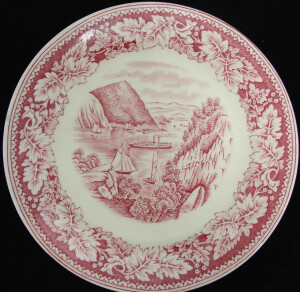 | SHORT DESCRIPTION: Rose color saucer with a view of the Hudson River with steamboat and sailing craft, highlands in foreground and in background and floral design on border on obverse. On the reverse side is an inscription. Manufactured by the Homer Laughlin China Company. The image is based on a view by Currier & Ives. NOTES: [History from Laurelhollowpark.net, maintained by Mark Gonzalez, on the Homer Laughlin China Company] The Homer Laughlin China Company is now known as The Fiesta® Tableware Company. Information from a Homer Laughlin advertisement dated January, 1929: In 1871 Homer Laughlin and his brother, Shakespeare Laughlin, built a two-kiln pottery at East Liverpool, Ohio. This was one of the first plants erected in this country for the making of white-ware. In 1897 Homer Laughlin withdrew from the business, and the present corporation was formed. Since then the growth has been remarkable. A greatly enlarged plant was built in 1899, but in two years this proved inadequate for the growing business, and a third large plant was built in the group at East Liverpool. By 1905 it was again necessary to expand. The great site at Newell, West Virginia was purchased, and the then largest single pottery unit in the world was erected, consisting of thirty kilns under one roof. The business continued to grow rapidly, and in 1914 Plant No. 5, consisting of sixteen kilns, was built at Newell, bringing the total capacity up to seventy-eight kilns. The increasing demand for Homer Laughlin ware necessitated further expansion in 1923, when the continuous tunnel kiln unit, Plant No. 6, was erected. In 1927 a new unit was added, Plant No. 7. On May 25, 1939, Joseph M. Wells informed art director Frederick Hurten Rhead that Montgomery Wards wanted a special line with "printed American patterns." Two weeks later, Rhead went to Chicago, Illinois to meet with Montgomery Wards on the new line and other HLC wares. Later that day, he noted in his journals going to the Chicago Art Museum, Chicago Public Library, and bookstores to hunt for Currier and Ives subjects. On June 11th and 12th, Rhead worked on Currier and Ives treatments to be used on the same shapes as Willow. After meeting with Ed Fry (buyer for Wards) the shapes and patterns were decided upon and work began on the new line on June 19, 1939. Wards offered the line, called Americana, from 1940 until 1956. Each piece has a special Currier and Ives scene with the title is printed in the backstamp in red. The official treatment number for the line was W-2553. An advertisement from the 1950s describes the line as: “...the first ware of its kind to equal the distinguished quality and soft rose-pink color of fine imported ware. Americana has scenes taken from the finest Currier and Ives prints - printed from copper engravings under the glaze so they can never come off.” | CL5035 | |||||||
| 7 | 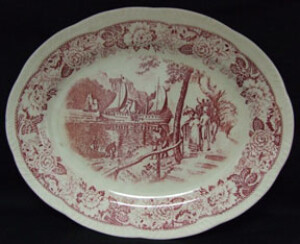 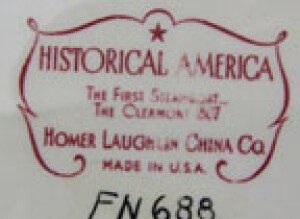 | SHORT DESCRIPTION: Oval ceramic platter with red transferware image of the 1807 steamboat Clermont with two sailing vessels in the background and a group of men and women on a path beside the river in the foreground. Detailed floral border. Scalloped edge. Maker's mark on the reverse side. Manufactured by the Homer Laughlin China Company. The image is based on an artwork by Joseph Boggs Beale. NOTES: [History from Laurelhollowpark.net, maintained by Mark Gonzalez, on the Homer Laughlin China Company] The Homer Laughlin China Company is now known as The Fiesta® Tableware Company. Information from a Homer Laughlin advertisement dated January, 1929: In 1871 Homer Laughlin and his brother, Shakespeare Laughlin, built a two-kiln pottery at East Liverpool, Ohio. This was one of the first plants erected in this country for the making of white-ware. In 1897 Homer Laughlin withdrew from the business, and the present corporation was formed. Since then the growth has been remarkable. A greatly enlarged plant was built in 1899, but in two years this proved inadequate for the growing business, and a third large plant was built in the group at East Liverpool. By 1905 it was again necessary to expand. The great site at Newell, West Virginia was purchased, and the then largest single pottery unit in the world was erected, consisting of thirty kilns under one roof. The business continued to grow rapidly, and in 1914 Plant No. 5, consisting of sixteen kilns, was built at Newell, bringing the total capacity up to seventy-eight kilns. The increasing demand for Homer Laughlin ware necessitated further expansion in 1923, when the continuous tunnel kiln unit, Plant No. 6, was erected. In 1927 a new unit was added, Plant No. 7. NOTES: [History from Laurelhollowpark.net, maintained by Mark Gonzalez, on the Homer Laughlin China Company] In late 1941, the Homer Laughlin China Co. made plans to produce a line which would feature early American scenes reproduced from Joseph Boggs Beale paintings as a Woolworth's exclusive. The new shape was named 'Liberty' probably given to reflect the patriotic theme of the Beale treatments. One of the first mentions in Frederick Hurten Rhead's (art director for the company from 1927-1942) journals regarding the new line occurred on December 23, 1941: 'Mr. J.M. Wells also asked about the subjects for the Beale series. Understand that the series is to be done by the photo-engraved method.' The first Liberty piece modeled was the 9" plate on January 1942. After being accepted, the following items were created from mid-January to early March; 10", 8", 7", 6", plates, tea cup and saucer, sugar, oatmeal, creamer, deep plate, 8" and 9" nappies, 8" baker, and the 12" oval platter. From late March to June, work commenced on creating the various patterns for Liberty. On Monday, June 22, 1942, an entry in Rhead's journals discuss the new treatments: Beale samples out this afternoon. Could be a lot better printing. Most items lack detail and fine tonal variations. Work commenced on improving the quality of the prints, but on July 24, 1942, another change was made - this time with regard to the shape which resulted in a heavier and sharper gadroon edge. In August and September all the existing Liberty shapes were remodeled and a new items was added; the sauceboat. Towards the end of 1942, the revised Liberty shape and the perfected Beale patterns, now called, "Historical America" were put into production. Historical America in red was treatment number W-449 and blue was W-342. Two more items would be added in 1943: the covered casserole in February and the teapot in late March. Historical America was produced for many years and is relatively easy to find in today's market. Red is by far the most common color, but blue examples can also be found. The Liberty shape was also used for decaled lines and other underglaze treatments. It became one of HLC's best selling shapes with production lasting until the 1960s. Historical America will have its own special mark along with the title of the Beale work, but decaled Liberty will carry the general HLC backstamp. Other historical images in the series included: Betsy Ross Showing the First Flag, Benjamin Franklin's experiment, the Arrival of the Mayflower, George Washington Taking Command of the Army, 1775, the Purchase of Manhattan Island, the First Thanksgiving, Barbara Fitchie, the Star Spangled Banner, and Lincoln's Gettysburg Address. | CL5001 |
Created 2026 by Don Barker, CBMM volunteer, for the Chesapeake Shipbuilding Project. shipbuilding@sailingworkboats.es